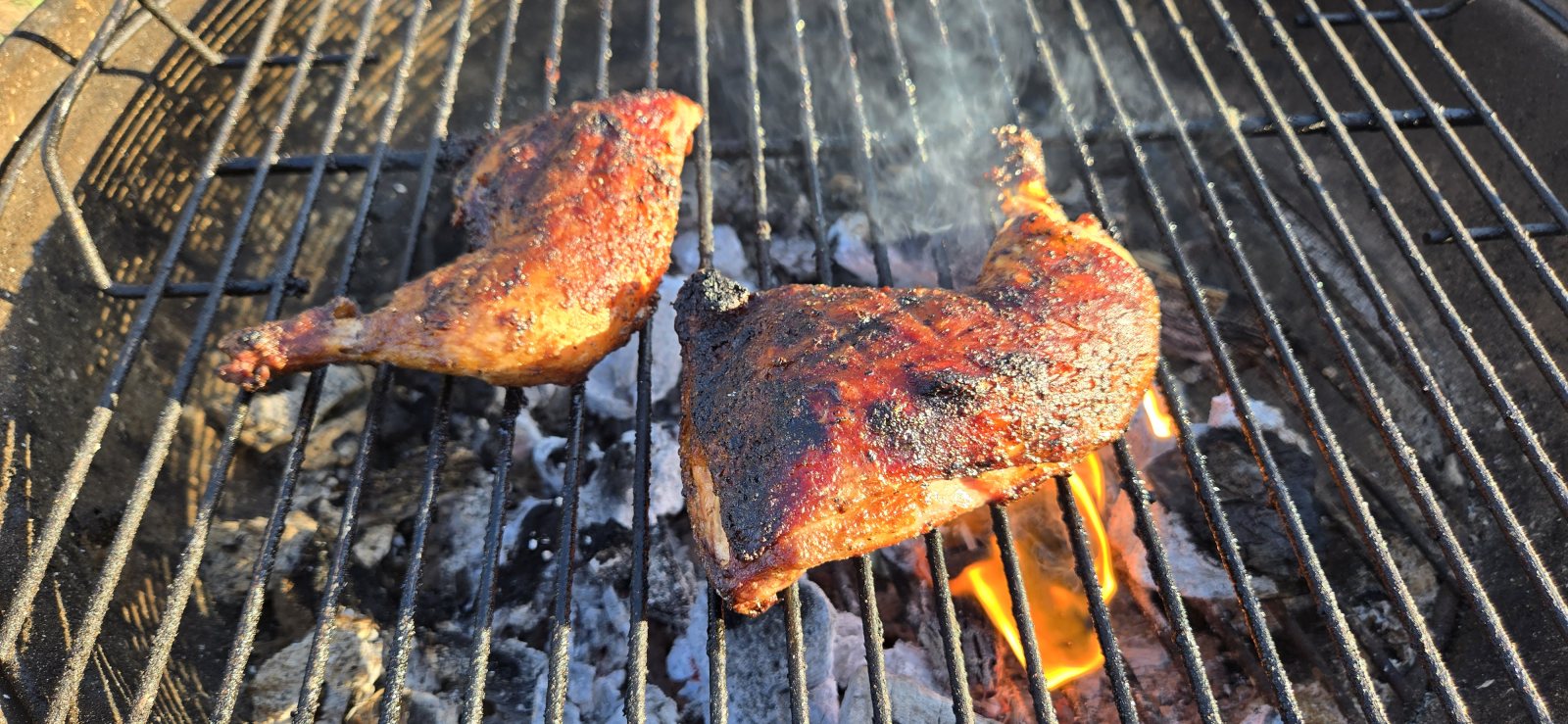
Cornell-style chicken isn’t about thick, sweet BBQ sauce. It’s vinegar-forward, savory, and built for charcoal. The secret is a simple basting sauce you brush on early and often, then heavier near the end of the cook
For this cook, I used that Cornell method but seasoned the chicken generously with PyroDust BBQ Dry Rub CoopDust first. The result is crispy skin, juicy meat, and a bite that’s pure backyard BBQ.
What makes this method different
Cornell chicken is the opposite of “sauce at the end.”
- Vinegar-and-oil baste, not a thick glaze
- Brush it on at each turn, light at first and heavier near the end
- Turn often and manage the fire instead of trying to “set and forget”
That basting plus charcoal heat is what creates the flavor.
Ingredients
Chicken
- Chicken leg quarters
- PyroDust BBQ Dry Rub CoopDust, generous amount
Cornell-style basting sauce
Cornell Cooperative Extension version (you can scale as needed)
- 1 egg
- 1/2 cup cooking oil
- 1 cup cider vinegar
- 2 tablespoons salt
- 1 1/2 teaspoons poultry seasoning
- 1/4 teaspoon white pepper
Mixing method matters: beat the egg, add oil and beat again, then add the rest and stir
Leftovers can be stored in a glass jar in the fridge
Prep
- Pat the chicken dry.
- Season all sides heavily with CoopDust. Don’t be shy, chicken can take it.
- Let it sit while the charcoal comes up.
Grill setup
-
Charcoal grill with zones. You need at least:
- Direct hot (to set color and tighten skin)
- Indirect (to cook through without scorching)
Wait until the coals are ready and the heavy flames calm down. Cornell’s method specifically has you put the chicken over the fire after the flame is gone so you’re cooking on heat, not flare-ups.
The cook
This is exactly the sequence I used.
Step 1… Direct heat to set color and skin
Start the chicken over direct heat to set the color and start tightening the skin.
- Turn often, you’re not trying to burn it.
- Light basting early is fine, but don’t drench it yet. Cornell’s approach is light at first and heavier near the end
Step 2… Indirect to cook through
Once you’ve got the color you want, move to indirect heat and let it cook through.
- Keep turning every 5–10 minutes depending on heat
- Baste at each turn with a brush.
Step 3… Medium/direct to crisp the skin
When you’re close to done, bring it back to medium/direct to finish the skin.
- This is where you can baste a little heavier.
- Watch for flare-ups and move it off the fire if it gets too aggressive.
Total cook time is typically around an hour depending on heat and chicken size
Doneness
Cornell’s classic doneness check is pulling the wing away from the body. If it splits easily and there’s no red color in the joint, it’s done
For accuracy, I also use temps:
- Breast: 165°F
- Leg/thigh: 175–190°F for best texture
What to expect
- Charcoal flavor and deep color
- Tangy, savory baste
- CoopDust gives it that “BBQ chicken” backbone
- Skin that finishes crisp instead of rubbery
Tips that make it easier
- Keep a small bowl of sauce and a dedicated brush at the grill.
- Baste every turn, but follow the rule: light early, heavier near the end
- If the fire gets wild, go indirect until it calms down.
- Rest 5–10 minutes before serving.
Quick summary
Season heavy with CoopDust.
Direct heat for color…
indirect to finish…
medium/direct to crisp the skin.
Baste every turn, light early and heavier near the end
Source and credit
The Cornell-style basting sauce and the “baste early and often” charcoal chicken method trace back to Cornell Cooperative Extension Information Bulletin 862, written by Dr. Robert C. Baker.
If you want the original reference material, here are the two source documents:
-
Cornell Cooperative Extension one-page recipe (scaled for small or large cooks)
https://ccefm.wordpress.com/wp-content/uploads/2011/05/cornell-bbq-sauce.pdf -
Original Cornell bulletin (Information Bulletin 862) by Dr. Robert C. Baker, hosted by Cornell’s digital repository
https://ecommons.cornell.edu/server/api/core/bitstreams/b0de1fdc-775d-48fb-8c0d-f6d6ceca54f0/content
Full credit to Dr. Baker and Cornell Cooperative Extension for the original sauce and method, I’m simply documenting my cook and how I apply it with PyroDust BBQ Dry Rub CoopDust.
Keep learning